
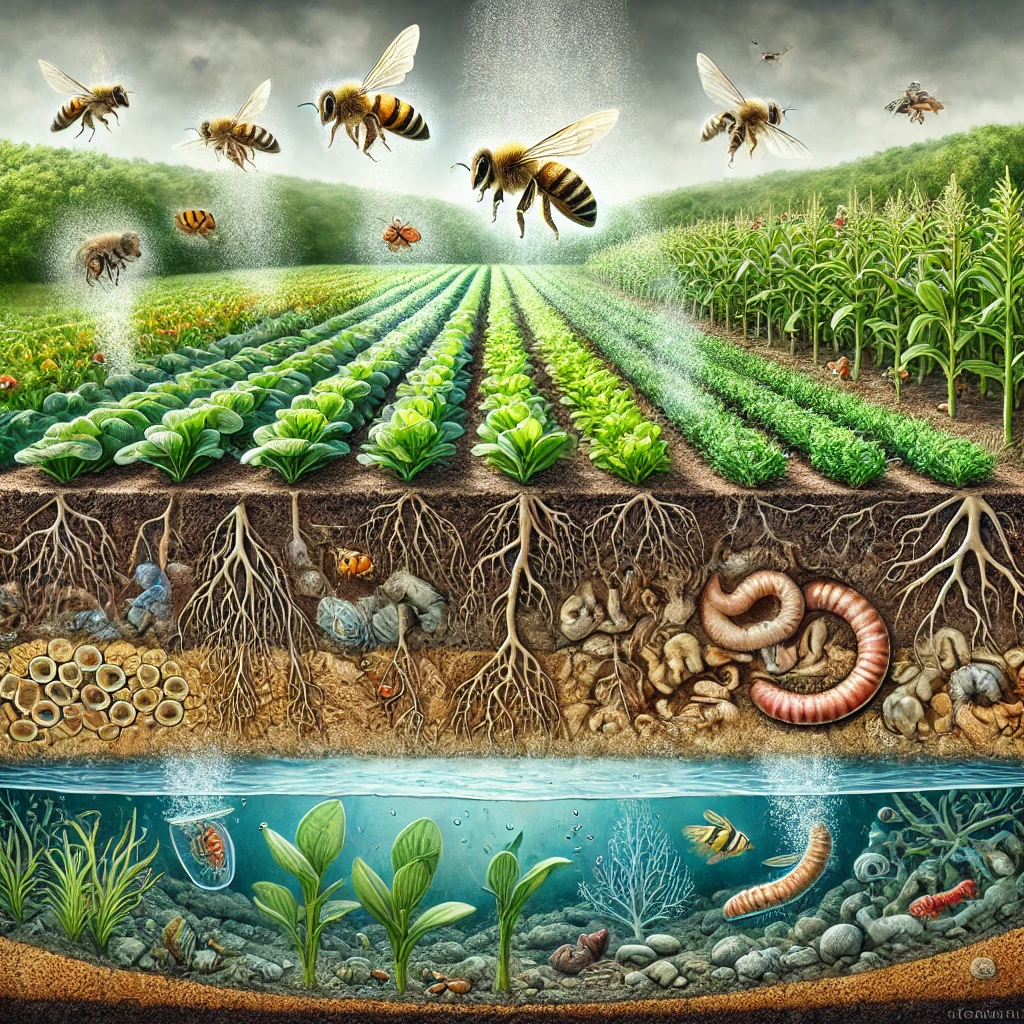
Understanding EIQ: The Best Metric We Have (For Now) to Measure Pesticide Impact
When it comes to regenerative agriculture, buzzwords like sustainability, resilience, and eco-friendly inputs get thrown around often — but how do we actually measure environmental impact in a tangible, data-driven way?
Enter the Environmental Impact Quotient, or EIQ.
Developed in the early 1990s at Cornell University, the EIQ was designed to offer growers, researchers, and policymakers a single numerical value that captures the real-world ecological risk of pesticide use — factoring in not just human toxicity, but also broader environmental impact.
Who Created the EIQ?
The EIQ was formulated by Dr. Joseph Kovach, a researcher at Cornell University’s Integrated Pest Management (IPM) Program, in collaboration with his team. They recognized a serious gap in pesticide evaluation: most rating systems were overly simplified, focused only on acute toxicity, or failed to address long-term ecological damage.
Kovach’s work culminated in the development of the EIQ model in 1992 as a way to standardize the evaluation of pesticides across different crops, chemicals, and geographies.
You can read the original publication and ongoing research hosted by Cornell University’s NYS IPM Program here:
https://cals.cornell.edu/new-york-state-integrated-pest-management
The Formula: How EIQ Works
Unlike most regulatory metrics that look at single-exposure or toxicity thresholds, EIQ incorporates 13 variables that measure pesticide impact across three categories:
- Farmworker Impact
- Consumer Impact
- Ecological Impact
Here’s the full formula:
EIQ = [(C × DT × 5) + (C × P)] + [(S × P) + (SY × L)] + [(F × R) + (D × Z) + (B × P)]
Where:
- C = Chronic toxicity
- DT = Dermal toxicity
- P = Plant surface half-life
- S = Soil half-life
- SY = Systemicity
- L = Leaching potential
- F = Fish toxicity
- R = Runoff potential
- D = Bird toxicity
- Z = Bee toxicity
- B = Beneficial arthropod toxicity
Each variable is assigned a score based on published toxicological data. The output is a single EIQ value that represents the chemical’s environmental footprint.
Is EIQ Perfect? No. But It’s the Best We’ve Got.
While no metric is flawless, the EIQ stands out because it attempts to balance the complex interplay between chemical persistence, toxicity, and mobility in the environment — in ways most government-approved labels do not. Yes, farming practices, application methods, and formulations are always evolving. And yes, EIQ might be updated or improved as science advances. But as of today, it’s the most robust, science-backed metric we have to evaluate environmental impact — especially for regenerative growers aiming to reduce their ecological footprint.
Can EIQ Change Agriculture?
Absolutely — and here’s why:
- Benchmarking Crop Programs: EIQ gives us a new lens to assess how “clean” a crop is, not just in terms of residue, but full ecological impact.
- Data-Driven Marketing: Imagine labeling crops not just as “organic” or “non-GMO,” but with a verified EIQ score — creating a new standard for sustainability that consumers and buyers can trust.
- Field Program Comparisons: Agronomists and advisors can now compare spray programs across farms, crops, and regions with a common EIQ framework — potentially guiding transitions away from high-impact inputs.
The Future: Can EIQ Become a Universal Language?
The short answer: it should.
At Regen Ag Nation, we believe that metrics like EIQ could become the new currency of sustainability — more powerful than blanket claims or marketing buzzwords. As pressure mounts from consumers, regulators, and buyers to validate environmentally friendly practices, the ability to assign a numerical score to impact could become a critical differentiator.
Our mission is to build transparency, trust, and clarity in the regenerative ag space — and tools like EIQ help make that possible.
Benchmarking the Future
EIQ isn’t just another academic concept. It’s a tool that can redefine how we grow, measure, and value crops in a regenerative future. As agriculture pushes forward into carbon markets, ESG tracking, and ecological accountability, EIQ might just be the baseline that gets us there.
Reference:
Listen to our Business Development Lead, Roger McKinley talk about EIQ:
Cornell University – Environmental Impact Quotient (EIQ)
https://nysipm.cornell.edu/eiq


